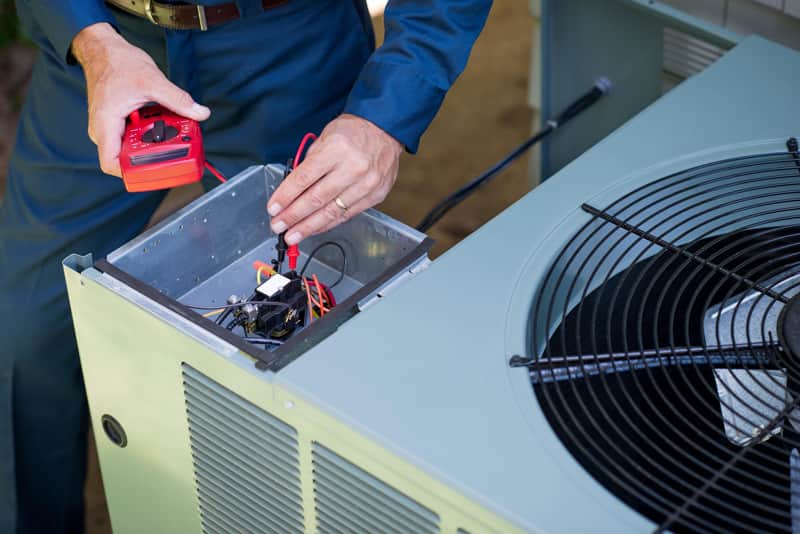
Emergency cooling service — Southwest Ohio
Emergency Air Conditioning Repair
When cooling fails in the middle of an Ohio summer, indoor temperatures climb fast. We diagnose the actual fault — electrical, refrigerant, airflow or drainage — explain what we find, and give you the price before any work begins.
- Covers
- Central air conditioning, indoor and outdoor equipment
- Service area
- Hamilton, OH and 10 nearby communities
- Pricing
- Diagnosed first, priced and approved before any repair
Start here
What Is Your Air Conditioner Doing?
Pick the closest description. Each one explains what it usually points at and what a technician checks first — so you know what to expect before anyone arrives.
The system runs, but the air isn’t cold
The blower is moving air and the thermostat is calling for cooling, but nothing coming out of the vents is cold. That usually points at the outdoor half of the system — refrigerant charge, a failed capacitor or compressor, or a control fault telling the condenser not to run at all.
What we check first
- Whether the outdoor unit is receiving the call for cooling
- Contactor and start capacitor condition
- Compressor and condenser fan operation
- Refrigerant pressures and temperature split at the equipment
Air is cold, but there isn’t enough of it
Restricted airflow is most often a clogged filter, a blower problem, or ice forming on the indoor coil. It is worth taking seriously rather than living with — a system starved of airflow runs colder than it should, which is how coils freeze and compressors get damaged.
What we check first
- Filter condition, and whether it is the right size and fit
- Blower motor, wheel and speed setting
- Indoor coil for ice or accumulated dirt
- Return and supply restrictions, including closed or blocked vents
Nothing happens when the thermostat calls for cooling
When a system is completely unresponsive, the cause is commonly electrical or a safety device doing its job, rather than the air conditioner itself having failed. A blocked condensate drain, for example, will deliberately lock the system out to stop it flooding.
What we check first
- Breaker position and the outdoor disconnect
- Thermostat power, settings and wiring
- Condensate float switch and drain pan level
- Low-voltage transformer and control fuse
Ice on the coil or the refrigerant lines
Ice is a symptom, not the fault. A coil freezes when it runs colder than it should, which usually traces back to low airflow or low refrigerant. Running the system while it is iced up will not cool the house and can damage the compressor.
Right now: Turn the cooling off at the thermostat and set the fan to ON. That helps the coil thaw. Do not chip at the ice, and do not run cooling again until the system has been looked at.
What we check first
- Airflow path — filter, blower and coil — once the ice has cleared
- Refrigerant charge, and whether a leak is responsible
- Metering device and indoor coil condition
- Condensate handling, since a large thaw has to drain somewhere
Water where it should not be
Cooling produces condensate, and it has to drain somewhere. Water around the indoor equipment usually means the drain line is blocked, the pan has failed, or a condensate pump has stopped. It is worth treating as urgent because of what it can damage — ceilings, flooring and the equipment itself.
What we check first
- Condensate drain line and trap for blockage
- Drain pan condition and the float safety switch
- Condensate pump operation, where one is fitted
- Whether a thawing coil is the actual source of the water
The breaker trips again as soon as you reset it
A breaker that trips repeatedly is protecting the circuit from something — a shorted component, a failing motor drawing too much current, or damaged wiring. Resetting it over and over is not a fix, and it is one of the few HVAC faults that carries a genuine fire risk.
Right now: Leave the breaker off and call. Do not keep resetting it.
What we check first
- Compressor and fan motor current draw against rating
- Capacitor and contactor condition
- Wiring, connections and insulation for damage
- Whether the breaker itself has weakened
Hearing loud buzzing, grinding or rattling, or seeing the system run continuously without ever satisfying the thermostat? Both are worth treating as urgent — turn the system off and call.
Scope of service
What an Emergency AC Call Covers
A cooling failure can come from four different directions, and they look alike from the thermostat. Every emergency call works through all of them rather than stopping at the first plausible answer.

- 01
Full system diagnosis
The cooling system is tested rather than guessed at — indoor and outdoor equipment both, because a fault in one shows up as a symptom in the other.
- 02
Electrical checks
Contactor, capacitor, motor current draw, safety switches and connections, since a large share of no-cooling calls are electrical rather than mechanical.
- 03
Refrigerant and performance
Operating pressures and temperature split measured at the equipment, which is what separates a low charge from a compressor or airflow problem.
- 04
Airflow and condensate
Filter, blower, coil condition and the full condensate path, including the float switch that will shut a system down when a drain backs up.
- 05
A plain explanation
What failed, why it failed, and what your options are — in language that lets you make the decision rather than defer it.
- 06
Approval before any repair
The recommended work and its pricing, given to you before anything is touched. Nothing proceeds until you approve it.
What happens
From Your Call to Cold Air
Five steps, and you are told where you stand at each one.
Right away
You call
Call (513) 555-0142 and tell us what the system is doing. We check for anything that needs handling before a technician arrives, and confirm your address is in our service area.
On that call
We give you the timing
Arrival depends on your location, current demand, weather and technician availability. We tell you what to expect while you are still on the phone rather than leaving you guessing. Urgent calls are prioritized.
On arrival
Diagnosis on site
Your technician tests the system — electrical, refrigerant, airflow and condensate — and identifies what actually failed rather than replacing parts hopefully.
Before anything is repaired
You approve the work
You get the recommended repair and its pricing first. If there is a decision worth making — repair now, or replace — you will hear it straight.
Same visit, where parts allow
Repair and verify
Once authorized, we complete the work and test the system through a full cooling cycle to confirm it is operating properly before we leave.
Cost and approval
How Pricing Works
We don’t publish a flat price list for emergency AC repair. The same symptom — no cold air — can be a small part or a failed compressor, and a number posted online would be a guess dressed up as a quote.
We diagnose before we quote
The same symptom has several possible causes. A number offered before anyone has tested the system is a guess, and guesses have a way of growing once the work starts.
You hear it in plain terms
What failed, what it takes to put right, and what that costs — explained before anything is touched, not itemised on an invoice afterwards.
Nothing proceeds without your approval
No work begins until you have agreed to it. That includes any additional work discovered partway through a repair.
We say so when a repair isn’t worth it
If the sensible answer is replacement, or simply waiting, you will hear that too. Selling you a repair that will not last is not a service.
Where we work
Emergency AC Repair Across Southwest Ohio
Based in Hamilton, Ohio, covering the surrounding Butler and Warren County communities. Not sure whether your address is in range? Call and we’ll confirm.
- Hamilton
- Middletown
- Lebanon
- Mason
- West Chester
- Trenton
- Liberty Township
- Fairfield
- Franklin
- Springboro
- Deerfield Township
Before you call
Air Conditioning Questions
My AC is frozen. Can I just turn it back on once the ice melts?
You can, but it will almost certainly freeze again. Ice is a symptom of something else — usually restricted airflow or low refrigerant — and thawing the coil does not address either.
Turn cooling off at the thermostat and set the fan to ON to help it thaw, then have the system diagnosed before running it again.
The breaker keeps tripping. Is it safe to keep resetting it?
No. A breaker that trips repeatedly is protecting the circuit from a real fault, commonly a shorted component or a motor drawing more current than it should. Repeatedly resetting it defeats that protection and carries a genuine fire risk.
Leave it off and call.
Should I leave the system running until a technician arrives?
It depends on what it is doing. If you hear grinding, buzzing or banging, smell anything burning, or can see ice or water around the equipment, turn it off — continuing to run damaged equipment usually makes the repair larger.
If it is simply not cooling well and nothing sounds or smells wrong, leaving it off is still the safer choice.
Do you work on both the outdoor unit and the indoor equipment?
Yes. A central cooling system is both halves working together, and a fault in one routinely presents as a symptom in the other — a blocked condensate drain indoors will shut the whole system down, and a failing outdoor capacitor will leave the indoor blower running with nothing cold to move.
Diagnosing only the half that looks suspicious is how problems get missed.
Will I know the cost before the repair begins?
Yes. After diagnosing the problem, your technician will explain the recommended work and associated pricing before beginning an approved repair.
How quickly can someone arrive?
Arrival times depend on your location, current demand, weather conditions, technician availability, and the nature of the problem. Urgent calls are prioritized, and our team will communicate the expected timing when you contact us.
Request service
Tell Us What Your System Is Doing
Send us the details and we’ll follow up. For anything urgent, calling is faster.
In an emergency, call. It is the fastest way to reach us.
Call (513) 555-0142Rather not use the form?
Calling is the fastest way to reach us, and the only one worth using if your situation is urgent.
service@ohioemergencyhvac.com
Based in Hamilton, OH. Available 24/7 — urgent calls are prioritized.
Don’t Let an HVAC Failure Disrupt Your Home
Get help from a local HVAC team focused on responsive service, dependable workmanship, and clear communication. Call Emergency HVAC Ohio now to request emergency heating or cooling assistance in Southwest Ohio.
Serving Hamilton, Fairfield, Middletown, West Chester, Liberty Township, Mason, and nearby communities.